Table of Contents
- What distinguishes an upholstery fabric wallet from all others?
- What to look for in photos – a specific list
- How much work goes into one wallet and why it costs more
- A piece of couch in your pocket – about second-life fabric
- Frequently asked questions
I have a stack of scraps in front of me. Each one is different – this narrow one with stripes, this wide one in honey green, this small square of thick velvet. None of them looks like a “future wallet.” Yet, in a few hours, one of them will be carrying the cards and cash of someone who can’t tolerate ugly things and doesn’t have time to buy something twice.
If you’re looking for a handmade wallet, this article will give you specific tools: what to look for in photos, what to watch out for when ordering, and why wallets made from upholstery fabrics perform differently than anything else in this price range.
What distinguishes an upholstery fabric wallet from all others
Most wallet guides focus on genuine leather and faux leather. Fair enough – these materials dominate the market. But they overlook an entire category that far surpasses them in durability at a lower price: upholstery fabrics.
Why? Because upholstery fabrics aren’t made with wallets in mind. They’re made for sofas, armchairs, and chairs – things that are meant to withstand decades of daily use, friction, squeezing, and contact with clothing. Each such fabric passes the Martindale test – an abrasion resistance test that counts the number of friction cycles until noticeable wear occurs. Good upholstery fabric can withstand 30,000–50,000 cycles. For comparison, inexpensive clothing materials can withstand several thousand.
Wallets made from such fabrics, properly sewn, last 5–10 years without any signs of wear. Cheap wallets from chain stores usually last one season until the seams start to come loose and the corners wear out.
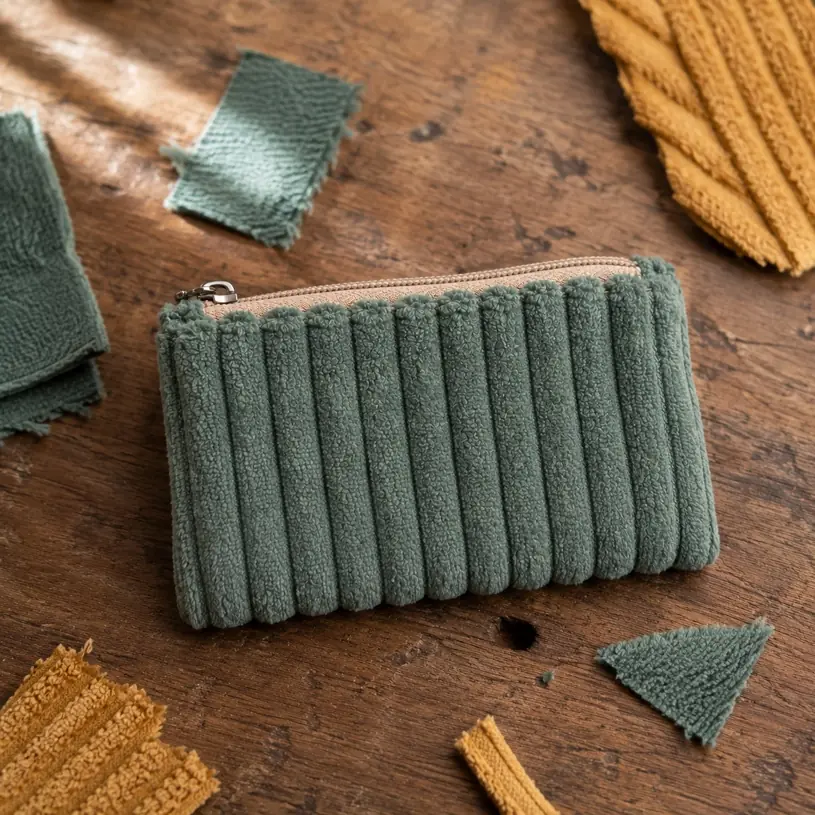
In Scoiattolo wallets, we use only upholstery fabrics – velvet, corduroy, bouclé – that have passed the same test as furniture in malls. This isn’t a slogan. It’s a material characteristic that has specific consequences in use.
What to look for in photos – a detailed list
When buying a wallet online, all you have are photos. And manufacturers – both handmade and mass-produced – know very well which areas to show and which to omit. The following list shows the things that really matter.
1. Stitching on Corners and Edges
The corners are the most difficult part of any wallet. In cheaply made wallets, the thread shifts or “jumps” where the material changes direction. Look for close-up photos – the seam should be even, without any bumps, and the thread should be free of loose loops.
2. Fabric Edges
Are the edges bound or hemmed, or is the raw fabric visible? Fraying edges are a sign that the manufacturer has shortened the finishing process – and that in a year or two, the wallet will look like a tattered mess.
3. Interior photos
A lack of photos of the wallet when it’s open is a red flag. A good store always shows the inside with cards or coins – this way you can see if the pockets are practical, if the lining is even, and if the compartments actually have capacity, not just suggest it.
4. In-hand photo
This allows you to assess the scale and thickness. Material that’s too thin folds in half already in the photo – the wallet doesn’t hold its shape without its contents. A good wallet should stand on its own.
5. Fittings and zippers
YKK zipper or equivalent? Are the clasps metal or plastic? For handmade items, these details are listed – if not, it’s worth asking.
Our wallet with two compartments in honey and green or card organizer wallet have all these photos – because there’s nothing to hide.
How much work goes into one wallet and why it costs more
A mass-produced wallet can be produced in a few minutes – a laser cuts dozens of identical pieces at once, and a machine joins them in a pre-defined pattern.
A wallet made of upholstery fabric looks different. I start with scraps – irregular pieces, none of which are identical in shape. Serial cutting is not possible: each element must be arranged individually, taking into account the texture, weave direction, and pattern. Then, sewing: each wallet is handcrafted by a single person from start to finish, from cutting through joining the elements, lining assembly, zipper installation, and finishing the edges.
The result: each wallet isIt’s the only one in the world. Literally – there’s no other wallet with the same fabric cut, because each piece has a different shape and pattern.
This explains the price. Data from the handmade market confirms that customers are willing to pay more for the quality of the material and the work of their hands – not for a logo. And if you calculate the cost of a wallet in years of use (5-8 years with daily use), the difference compared to cheap alternatives is even more pronounced.
A piece of sofa in your pocket – about material given a second life
Every wallet from the Scoiattolo workshop is made from material that would normally end up in a dumpster. Furniture factories generate huge amounts of upholstery offcuts – pieces too small for further furniture production, but too good quality to throw away without regret. I collect these materials directly from the factories.
This isn’t a PR stunt. Textiles make up several percent of all municipal waste in the EU, and only 1% is actually recycled in a closed loop. Each wallet made from scrap is a specific piece of fabric that has been given a second life—instead of ending up in an incinerator.
By the way: these scraps are new materials, never used by anyone before. There are no second-hand shops or old sofas here—these are factory-made production waste in perfect condition.
Frequently asked questions
- Is a handmade wallet really more durable than a chain-store wallet?
- It depends on the material and workmanship. Wallets made from upholstery fabrics—designed for years of friction on furniture—are tested for tens of thousands of abrasion cycles. With solid sewing, such a wallet can last 5–10 years without visible signs of wear. Cheap wallets made of thin synthetic materials often don’t last two seasons.
- Which material should you choose for a handmade women’s wallet – leather or fabric?
- Genuine leather (full-grain) is durable and ages beautifully, but it’s more expensive and requires care. Heavy-weight upholstery fabrics are easier to maintain, resistant to abrasion, and available in a much wider range of textures and colors. The choice depends on your aesthetic preferences – in terms of durability, both options can last for years.
- How can you tell a well-made handmade wallet from a cheap mass-produced one?
- Look at the stitching at the corners (even threading, no skipping), the edges of the material (bound or sewn, not raw), and photos of the inside with the cards. A lack of photos of the inside in a handmade shop is a bad sign. Good workshops don’t hide anything.
- Is a handmade wallet a good gift?
- Yes – especially if you’re buying it as a unique piece. Wallets made from upholstered fabric are compact, hold cards and cash, and each piece has a different fabric pattern. If you’re looking for something more in a similar style, Scoiattolo bags and the entire wallet category can be combined into a gift set.
- How much does a handmade wallet cost and is it worth it?
- Wallets from handmade workshops typically cost 80–150 PLN. With 5–8 years of use, that’s 10–30 PLN per year – less than a cheap wallet bought every season. Plus, a single piece, no duplicates on the market, and a material with a documented history.
Which option to choose?
If durability is important to you, look for upholstery fabrics or genuine leather, not faux leather. If you want your wallet to look just as good in five years, check the stitching at the corners and the finished edges. If you want a story behind your purchase, check where the material comes from.
All Scoiattolo wallets have one thing in common: each one is a piece of fabric that was meant to be thrown in the trash. It didn’t.