Contents
- Where did the idea to make bags from sofa materials come from?
- The number that says it all: the Martindale test
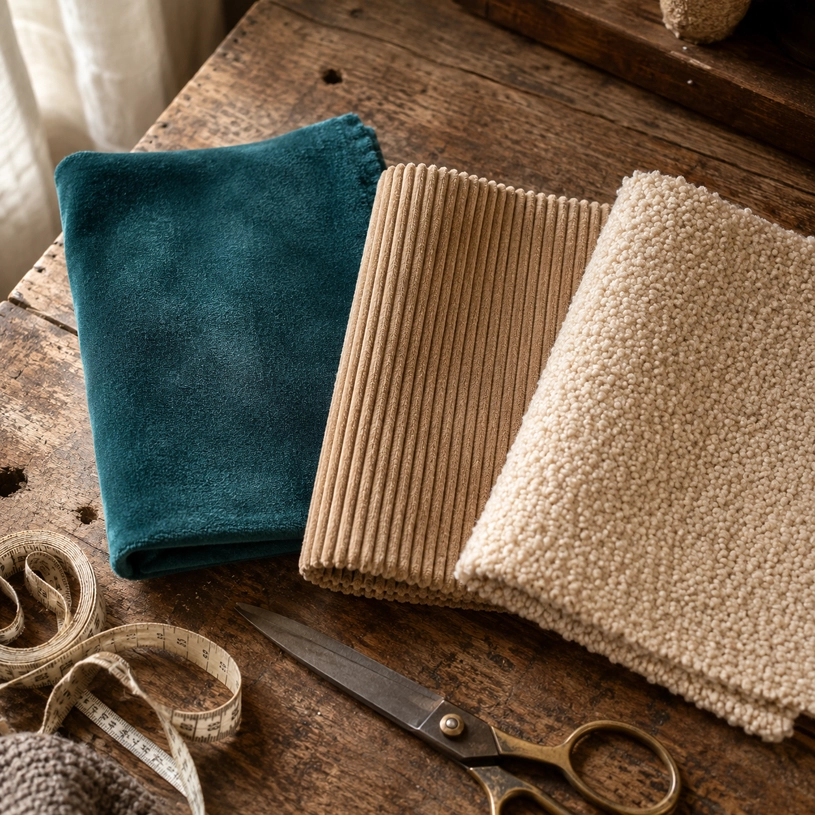
- Velvet, corduroy, bouclé – how do they differ in practice?
- Why are offcuts from furniture factories new, not used?
- Frequently asked questions
I received my first scraps of upholstery fabric by chance – an acquaintance with an upholsterer. When I picked them up, I knew immediately: this wasn’t clothing material. It felt different – heavier, denser, more condensed. I began to investigate why. And so, in the studio on Kicińskiego Street, I began creating bags from materials that had previously ended up on furniture.
This article explains one thing: why natural fabrics used in upholstery—velour, corduroy, bouclé—are better for bags than typical clothing cotton. And it does so with numbers, not slogans.
Where did the idea to make bags from sofa materials come from?
Upholstery fabrics are designed with one thing in mind: durability. A living room sofa has endured several years of sitting, standing, moving, rubbing against clothing, spilled coffee, and dog paws. The material designed to withstand all of this is constructed differently than the fabric for a blouse or dress.
The difference begins with the weight. Lightweight summer cotton is around 130–160 g/m². Standard everyday clothing: 160–220 g/m². Upholstery fabrics: often 300–400 g/m² or more. A bag made of this material has an outer layer 1.5–2 times thicker than a classic cotton bag from a clothing store.
Effect: it does not deform under weight, does not wear out at the edges, and does not pill after several months of being worn over fences and door frames.
The number that says it all: the Martindale test
The Martindale test is an industry standard for measuring fabric abrasion resistance. A sample is rubbed with a standardized wool fabric in an oscillating motion, and the result is reported in cycles until the first visible damage occurs.
What do the individual thresholds mean:
- 10,000–15,000 cycles – decorations, occasional use (pillows, curtains)
- 15,000–25,000 cycles – standard home use (family sofa)
- 25,000–50,000 cycles – intensive home use
- over 45,000 cycles – category A: very durable materials
- over 100,000 cycles – public spaces, practically indestructible
The upholstery fabrics I use for sewing are rated for 30,000–100,000 cycles. Cheap clothing materials from popular chain stores are rated for around 5,000 cycles. A bag made of upholstery fabric can withstand several times more intense abrasion than a bag made of cotton clothing.
Nobody measures cotton bags with a Martindale. Why would they? The results would be embarrassing.
Check out the corduroy bag in dark beige and cappuccino or the corduroy shopper in teal and khaki – these are materials with this level of resistance.
Velvet, corduroy, bouclé – how do they differ in practice?
Upholstery fabrics are not a single material. Each type has a different character, texture, and behavior when used as a bag.
Upholstery velvet – soft, elegant, with a subtle sheen that changes depending on the viewing angle. Modern upholstery velvets often have a stain-resistant or hydrophobic finish – drops roll off the surface instead of soaking in. It works well in a bag as both an urban and evening option. It requires moderate care: it doesn’t require special maintenance, but it’s best not to rub it with a wet cloth against the grain.
Upholstery corduroy – distinctive stripes, a bit retro, a bit modern. Thicker and more durable than clothing corduroy – the same weave, but with a denser structure designed for frequent use. It effectively conceals minor signs of wear. The stitching must be aligned along the stripes to ensure a consistent pattern – this is one of the reasons why each bag is individually cut.
Bouclé – a looped, three-dimensional texture, intense and soft to the touch. Fashionable in designer furniture and premium clothing. In a bag, it creates a distinct character – a warm, wintery, “tweed” aesthetic. It’s best paired with smoother fabrics in areas prone to friction.
All these materials have one thing in common: they were designed for intensive, long-term use. The bag provides truly comfortable working conditions for them.
You’ll find a full selection of bags made from various upholstery fabrics in the Scoiattolo bag category. And if you’re interested in combining several fabrics into one design, patchwork bags are a geometric combination of different pieces in one form.
Why are offcuts from furniture factories new, not used?
A common question: isn’t this fabric from a disassembled couch? No.
In upholstered furniture production, fabric is unrolled from a bale and cut according to the sofa’s templates. After cutting out the main elements (backrest, seat, armrests), what remains are remnants – too small for the rest of the furniture, but too large and too good to be thrown away without regret. These offcuts have never been on any sofa, have never been used by any customer, and have never been washed. They were in a bale, then they went to the cutting table, and from there, to me.
This is an important distinction: this is upcycling a production material, not recycling a used product. The material is given its first and only life as a bag—not a second, not a refurbished one. The first.
The volume of textile waste in the EU is approximately 5.8 million tons per year – approximately 87% in Poland ends up in landfills or incinerators. The upholstery industry generates significant amounts of scrap that require management. A bag made from upholstery scraps is a concrete answer to this problem, not just a tagline.
You can find out more about what this work looks like on the Scoiattolo workshop website.
Frequently asked questions
- How do upholstery fabrics differ from clothing fabrics?
- They are heavier (300–400 g/m² versus 160–220 g/m² for standard clothing), denser, and tested for abrasion resistance according to the Martindale standard. Clothing fabrics are designed for comfort and aesthetics, while upholstery fabrics are designed for years of intensive use. In a bag, this translates into significantly longer durability.
- Is the upholstery fabric bag heavy?
- The bag itself weighs as much as a well-made canvas bag – the difference in material weight doesn’t drastically increase the final product’s weight. The thicker fabric, however, means the bag holds its shape even when empty and doesn’t sag under the weight of its contents.
- How to care for a bag made of upholstery fabric?
- Hand wash in lukewarm water, dry flat, do not tumble dry. Remove stains with a damp cloth in the direction of the weave. Velvet and corduroy do not require special impregnation, although many already have a factory-applied water-repellent finish.
- Are the upholstery fabrics natural?
- It depends on the specific material. Upholstery can be made of wool, cotton, or linen (natural), but also polyester microfibers or synthetic blends. At Scoiattolo, we primarily use velvet, corduroy, and bouclé of various compositions—we select them for durability and aesthetics, not for the marketing slogan “natural.”
A material that doesn’t need the “premium” label
Upholstery fabric doesn’t have to prove anything. It’s passed the Martindale test, weighs over 300 g/m², and has decades of industrial use in furniture that needs to last for years. A bag made of this material will simply do the trick – without sagging on your shoulders, without chafing after a few months, and without the need to buy another one next spring.
All handmade bags at Scoiattolo are made from these same materials.