Table of Contents
- Patchwork: a technique adopted by design out of necessity
- Upholstery vs. cotton patchwork – what’s the difference in practice
- How I plan each scrap list
- Why is a patchwork bag priced differently than a single-use bag
- Frequently Asked Questions
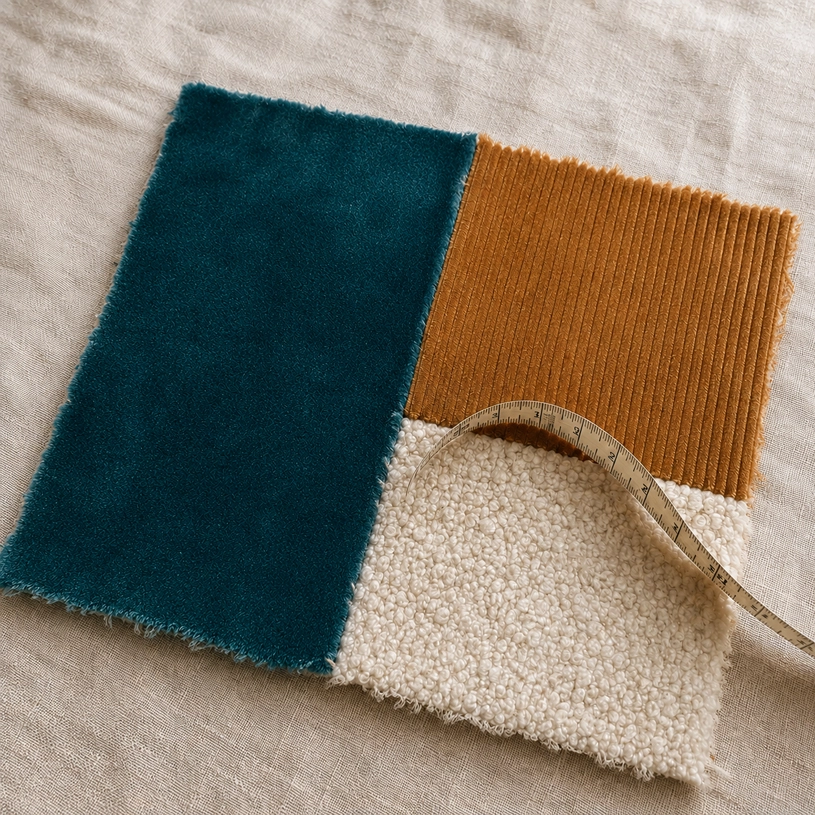
I don’t patchwork out of aesthetic choice. I do it out of necessity – and the results are the same. Upholstery scraps from furniture factories come in all shapes and sizes. When I receive a batch of scraps from cutting the back of a sofa, some are too small for a single-piece bag, but too large to throw away. Patchwork is the answer to this arithmetic. A dozen or so pieces, each from a different roll of fabric, become a single bag. When these scraps are used up, that particular combination disappears forever.
This article explains what a patchwork bag made of upholstery fabrics is, how it differs from classic cotton patchwork, and why the effect of this technique in a bag looks different than in a quilt.
Patchwork: a technique of necessity adopted by design
The word “patchwork” comes from the English “patch” and “work.” As a sewing technique, it dates back several centuries—and for most of that time, it was the technique of the poor, not the rich. Before the Victorian era, in England, a housewife would cut up trousers, a dress, or bedding and be left with pieces too small for anything. Patchwork was a way to avoid wasting a single inch of fabric.
Patchwork became a decorative art in the 17th and 18th centuries, when thrifty, but not necessarily poor, English housewives could afford it by piecing together scraps of expensive cotton fabrics printed with geometric patterns and squares. From England, the technique spread to America, Australia, and eventually everywhere. However, the same thing remains: patchwork is a technique of necessity. Nothing is wasted. Pieces that are useless individually create something new together.
Nothing has changed in this regard at Scoiattolo. Except that instead of a dress remnant, we have scraps from cutting up a sofa backrest. And instead of a quilt, we have a bag.
Upholstery vs. Cotton Patchwork – What’s the Difference in Practice
Most patchwork guides recommend smooth cotton to start with. This is good advice, not because cotton is better, but because it’s the easiest. Thin, flat, and easy to cut into even squares and triangles. Seams on cotton are ironed flat with your finger, so the fabric doesn’t “run away” under the presser foot.
Upholstery fabric patchwork presents a completely different level of technical difficulty:
-
- Upholstery velvet has a pile direction – pieces cut in different directions look like two different fabrics. Each piece must go in the same direction.
Bouclé and chenille “run away” under the machine’s presser foot – the layers shift against each other if you don’t clip them tightly enough.
Seams on several layers of thick fabric create lumps that can cause the machine to stop – a slower stitch is necessary, and often manual turning of the wheel is necessary for difficult areas.
Each seam must be ironed separately – with thick fabrics, the seams don’t lie flat on their own.
The effect of this work is also different. Cotton patchwork is a soft, flowing whole – it’s associated with a bedspread, quilt, or “cozy” style. The upholstery patchwork has an architectural form: the bag holds its shape, the textures are palpable, and light refracts differently on velvet than on smooth cotton. This is closer to furniture design than to home craftsmanship.
You can see the patchwork bag made of velvet and upholstery corduroy in lime, beige, gray, and checkered patchwork shopper bag – several fabrics combined into one geometric composition. A smaller format using the same approach is patchwork messenger bag in beige, brown, brick, and ecru – four sets of scraps forming one strip.
How I plan each scrap arrangement
A patchwork project starts with a table with scraps spread out. I don’t combine them randomly – I plan the arrangement so that the colors and textures complement each other, not clash. A few rules I follow:
Contrast in texture, not color. If I’m using two light fabrics, one is smooth (velour) and the other is textured (bouclé or chenille). Two smooth fabrics in a similar color blend together and lose the patchwork character. Two textured fabrics next to each other “clash” visually.
One neutral color as a binder. In every combination – even the most colorful – there is a neutral element: beige, ecru, gray, navy blue. It “usIt “unifies” the combination and makes the bag suitable for more than one style.
Geometry Direction. If one of the materials has a pattern—checks, corduroy stripes—the other pieces are chosen so as not to compete with the pattern, but to complement it. Therefore, a patchwork bag with a check pattern almost always has a plain velvet or smooth weave.
When the scraps from a given material combination run out, that particular version will no longer be available. A new supply of scraps means a new combination. There is no option to sew an identical bag—because there are no identical scraps.
I write more about where the materials come from and what this process entails on the website about the Scoiattolo studio.
Why is a patchwork bag priced differently than a plain one
Simple summary: a bag from a single piece of fabric requires cutting several The patchwork bag also requires cutting several to several dozen smaller pieces, carefully fitting them together (the edges must meet at one point, without “runaway” corners), ironing each seam, and only then sewing the entire bag together.
Upholstery fabrics also have the technical complexity described above – the direction of the pile, the thickness of the seams, and slower sewing on thickened areas. This translates to more hours of work on each project. A plus: each patchwork bag is a one-of-a-kind piece. “Limited edition” is a series. A bag made from scraps that are no longer available – it’s truly one-of-a-kind.
With the durability of the upholstery materials (30,000–100,000 Martindale cycles), this bag will be with you for years – which changes the price perspective from “expensive for a bag” to “cheap for years of wear.”
You can find all Scoiattolo patchwork bags at bag categories. If you’re looking for a smaller format – colorful patchwork messenger bag is the same idea on a smaller, everyday scale.
Frequently asked questions
- What is a patchwork bag and how does it differ from a regular fabric bag?
- A patchwork bag is a bag made from several or a dozen different pieces of fabric combined into a single panel. Instead of a single material, you get a composition of different colors and textures. At Scoiattolo, these are upholstery fabrics – velvet, corduroy, bouclé – which creates a more architectural and textured look than classic cotton patchwork.
- Is a patchwork bag durable for everyday use?
- With upholstery patchwork – absolutely. Upholstery fabrics are designed for decades of intensive use on furniture. A bag made of velvet or corduroy is much more abrasion-resistant than a bag made of typical clothing cotton. The seams at the patchwork seams are reinforced, and the bag’s bottom is stiffened.
- Why are handmade patchwork bags more expensive than chain stores?
- Sewing a patchwork bag involves several times more operations than a bag made of a single material – cutting a dozen pieces, fitting the edges together at a single point, ironing each seam, and only then building the bag. With upholstery fabrics, there’s an added technical challenge: the direction of the pile, the thickness of the stitches, and slower sewing. It actually takes more hours. Plus – each piece is a unique piece.
- Where does patchwork come from and why is it associated with zero quality? Waste?
- Patchwork is a centuries-old technique, historically the technique of the poor, who couldn’t waste fabric. Leftovers from cutting clothes and bedding were combined into quilts and throws. Today, upcycling brands use the same principle. At Scoiattolo, the material is upholstery offcuts from furniture factories – too small for another sofa, too good to throw away.
Each bag exists only once
The patchwork in a Scoiattolo bag isn’t a decoration for sale as a “unique product.” It’s a technique dictated by the nature of the raw material, resulting in a product unlike anything you could order in bulk. Each combination of offcuts is unique, each bag is a one-of-a-kind piece of this particular combination of materials. Once it’s gone, it won’t come back.
A full selection of handmade fabric bags upholstery – homogeneous and patchwork – in the current Scoiattolo collection.